California Air National Guard pararescuemen perform a rappel demonstration to at a Golden State Warriors basketball game in 2024. Air National Guard photo by Tech. Sgt. Duane Ramos. Air National Guard photo by Tech. Sgt. Duane Ramos.
Air Force Tech. Sgt. Ian Patterson, a Tactical Air Control Party instructor, died following a fatal fall from the rafters during a pre-game rappelling demonstration at the Alamodome in San Antonio. While some media commentary linked the incident to recent military marketing initiatives under Defense Secretary Pete Hegseth, military public rappelling demonstrations have been routinely conducted across the country for over a decade. An official Air Force investigation is underway to determine the cause of the accident and evaluate the safety procedures in place during the event.
The author criticizes the retraction of Neil Miller’s 2021 peer-reviewed paper from Toxicology Reports, which analyzed VAERS data concerning sudden infant death syndrome (SIDS). The journal cited methodological flaws regarding correlation inference, but the author contends VAERS data appropriately identifies potential safety signals requiring follow-up causation studies. Framing the retraction—and ongoing investigations into their own research—as unjustified censorship, the commentator questions why journal editors and online platforms like PubPeer scrutinize research on vaccine safety signals
An article by We Are The Mighty reports that historical accession records show 281 of the original 520 soldiers in the World War II 1st Ranger Battalion came from the 34th Infantry Division, a Midwest National Guard unit. This corrects decades-old unit histories claiming an 80% contribution. The excerpt details the 34th Infantry Division's WWII service, highlighting its status as the first American division sent to Europe, its heavy combat across North Africa and Italy, including at Monte Cassino, and its total of 16,401 battle casualties over 517 frontline combat days.
Harvard astrophysicist Avi Loeb is publicly challenging former Pentagon UFO investigator Jay Stratton regarding assertions that the United States government possesses nonhuman technology. While Stratton claims that the U.S. holds nonhuman technology, Loeb contends that extraordinary testimonial claims, regardless of the source's credibility, cannot replace empirical scientific evidence and physical proof. The feed excerpt highlights this ongoing debate over government UAP claims versus the need for verifiable scientific data, though full details of Loeb's challenge are truncated.
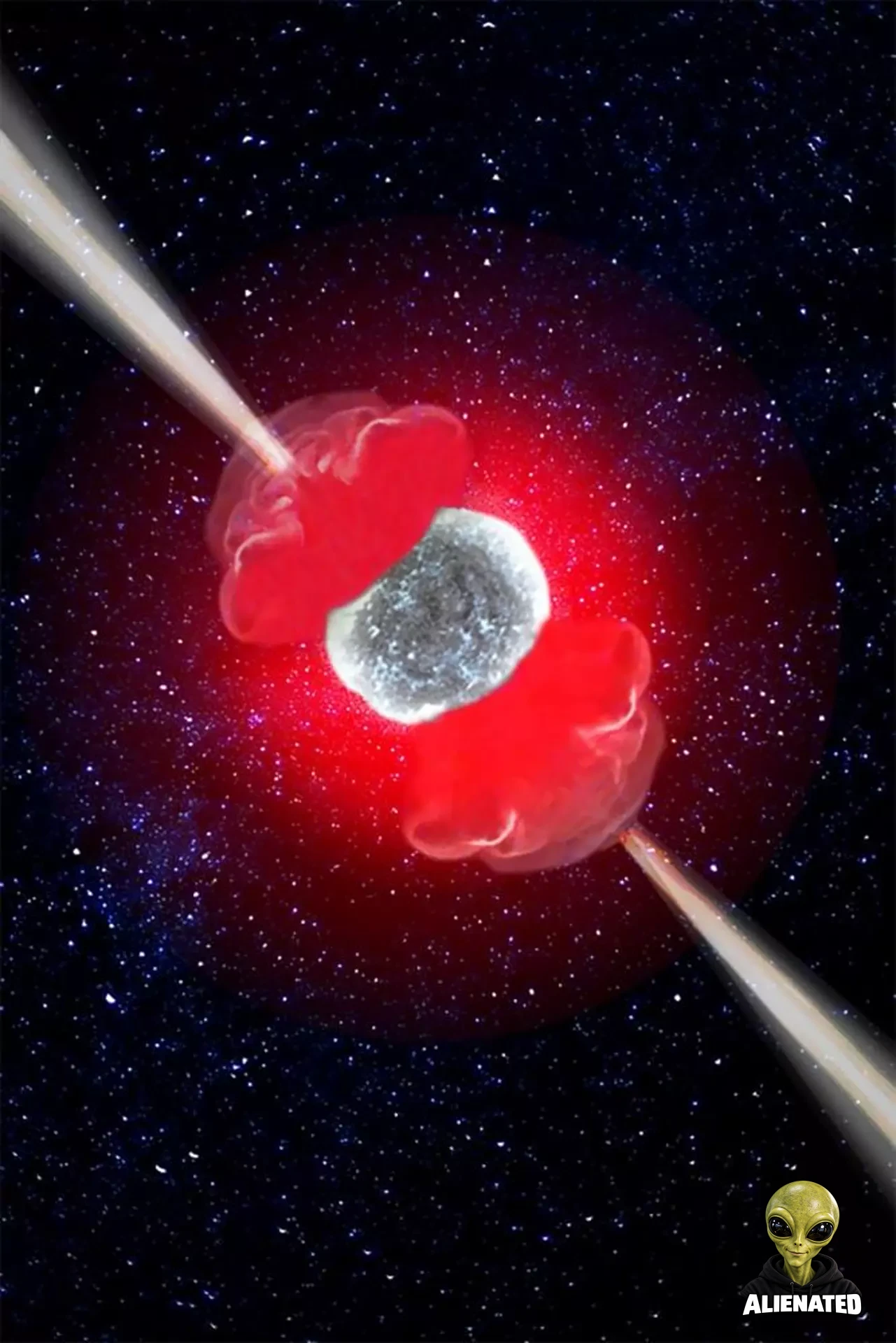
This artist's illustration shows a hypernova, an extremely luminous and energetic type of supernova. They occur when a star with more than about 30 solar masses reaches the end of its life and explodes. Evidence for them is thin, and new research pokes holes in what little there is. Image Credit: Anna Serena Esposito/Spanish National Research Council (CSIC)
According to Universe Today, astrophysicists have long considered hypernovae—the most energetic form of core-collapse supernovae—to be the most powerful stellar explosions in the universe. However, direct evidence supporting their existence remains sparse. New research now challenges the hypernova concept, suggesting that these extreme cosmic events may not actually occur. The excerpt highlights growing uncertainty surrounding these theoretical stellar phenomena, emphasizing that current observational data may be insufficient to confirm their existence.
According to a report by The Debrief, new research published in PNAS Nexus indicates Nazi Germany was significantly further from developing a nuclear weapon during World War II than previously claimed. Project leader Werner Heisenberg had asserted that the 1945 Haigerloch reactor was near achieving criticality. However, American researchers analyzing surviving uranium cubes and modeling the reactor concluded that reaching criticality was logistically impossible. Germany lacked sufficient heavy water production, and its available graphite was too impure, showing that the Nazi nuclear program fa